Your house is built. The last coat of paint is dry. Most families think the job ends there.
It doesn't.
Until you register your property, you haven't fully secured it. No registration, no legal proof of ownership. That gap trips up more self-build homeowners than any other step.
At Rever Homes, we've built over 100 homes across Gurugram and Delhi-NCR. We walk clients through this stage often, right after handover. Most know about DTCP approval before construction starts. Far fewer plan properly for registration after it ends.
This guide covers what registration means after self-construction, which documents you need, and what happens in Haryana specifically. If you're still at the planning stage, read our DTCP approval process guide for Gurgaon first. That step comes before this one.
Why Registration Still Matters After You've Built the House
Here's a common mix-up. People assume registration only applies when buying a ready flat from a builder. Not true.
If you built on your own plot, the land was likely registered when you bought it. But the completed structure on that land needs its own legal record too. Without it, your ownership claim stays incomplete in the eyes of the law.
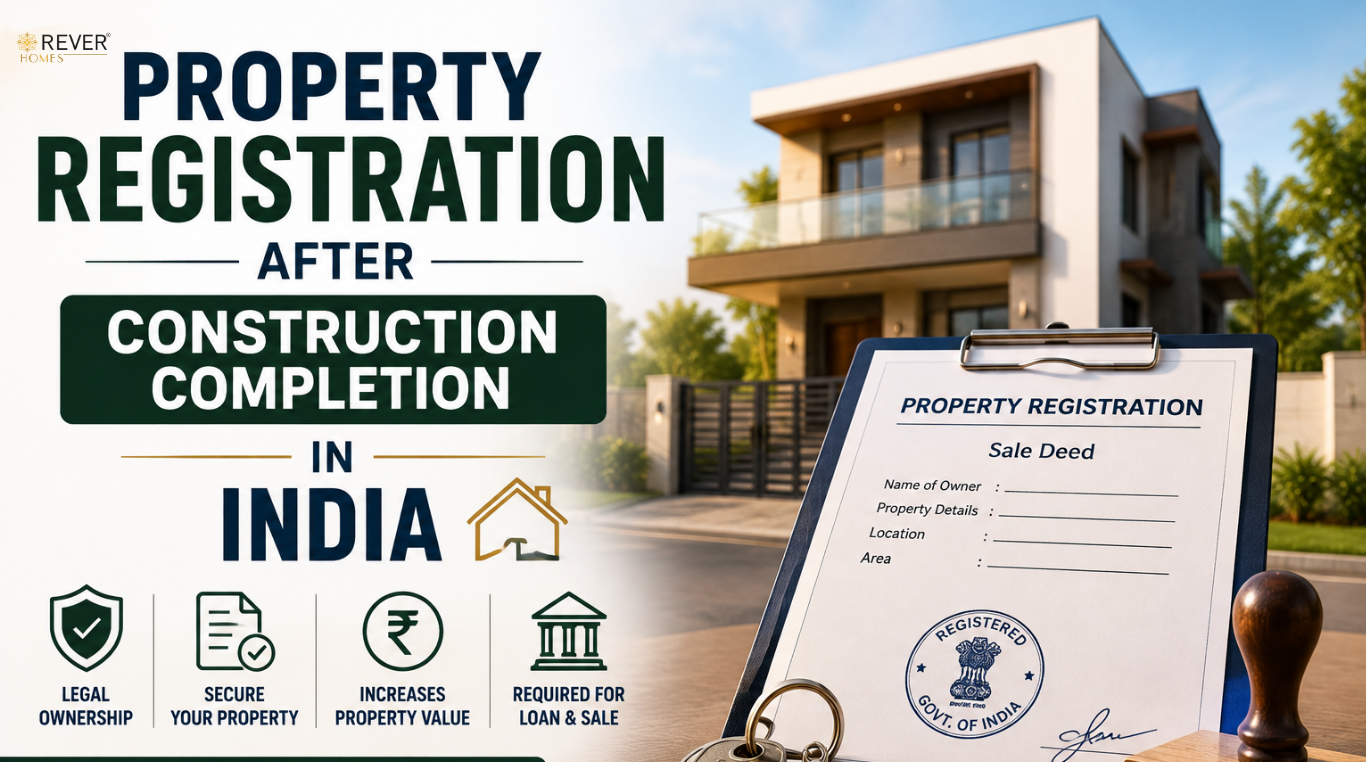
Under Section 17 of the Registration Act, 1908, any property transaction above a small value threshold must be registered. An unregistered document can't be used as proof of title in court. That single rule is why skipping this step is a real risk, not a technicality.
What Registration Actually Does
Registration creates a public record of your ownership. It's not the same as mutation, and it's not the same as your building's completion certificate. Each one plays a different role.
Registration transfers legal title. Mutation updates the government's revenue and tax records to match. Both matter. Skip either one, and you'll hit walls later with loans, resale, or property tax.
Documents You'll Need
Keep these ready before you approach the sub-registrar's office.
- Sale deed or original title documents for the land
- DTCP-sanctioned building plan
- Completion certificate from your architect or engineer
- Occupancy certificate, where applicable
- Identity proof (Aadhaar, PAN) for all parties
- Passport-size photographs
- Encumbrance certificate
- Property tax receipts
- Stamp duty payment receipt or e-stamp certificate
Missing the completion certificate is the most common holdup we see. Get this from your architect the moment construction wraps up. Don't leave it for later.
The Registration Process, Step by Step
Step 1: Check the Circle Rate
Every locality has a government-set circle rate, the minimum value your property gets registered at. Check this first. It determines your stamp duty and registration fee.
Step 2: Calculate and Pay Stamp Duty
Stamp duty is a state tax paid before registration. It's calculated on whichever is higher: your declared value or the circle rate. Most states, including Haryana, now allow e-stamping, so you can pay this online.
Step 3: Draft the Deed
Get your deed drafted with a complete property description, party details, and the paid stamp duty amount clearly stated. A lawyer or documentation expert usually handles this.
Step 4: Book a Sub-Registrar Appointment
Most states run this online now. Haryana does it through its digital portals. Pick a slot, upload your documents in advance, and avoid the long walk-in queues.
Step 5: Attend in Person
Both parties, or their authorised representatives, need to be present. Bring original documents. Biometric verification and witness signatures happen at this stage.
Step 6: Registration and Deed Collection
Once verified, the sub-registrar registers the document. You'll get a registered copy, often available digitally within days.
Step 7: File for Mutation
This is the step people forget. Registration alone doesn't update municipal or revenue records. You need to file for mutation separately, which we cover next.
Stamp Duty in Haryana: What to Expect
Haryana charges stamp duty based on whether your property sits in an urban or rural area. Urban rates run higher than rural ones, and the exact figure depends on your locality's circle rate. Women buyers get a rebate on top, which is worth checking before you finalise the deed.
Registration fees are separate from stamp duty, typically calculated as a percentage of the property's value, subject to a fixed cap. Pay both through the state's e-stamping and e-GRAS portals rather than the older manual route. It's faster, and it leaves a clean digital trail.
Mutation: The Step Most People Skip
In Haryana, mutation goes by a local name: dakhil kharij, or intkal. It updates the land revenue and municipal tax records to reflect your ownership.
Registration proves you own the property. Mutation makes sure the government's own records agree. Skip it, and property tax bills, utility connections, and future resale all get complicated, sometimes years down the line when you least expect it.
To file mutation, collect Form VII from the Tehsil or an Atal Seva Kendra. Attach your registered sale deed, jamabandi record, and identity proof. A patwari verifies the site and neighbour details before the Circle Revenue Officer signs off. The whole process usually takes a few weeks, sometimes longer if field verification gets delayed.
Don't assume mutation happens automatically after registration. In most cases, it doesn't. File it yourself, or through your documentation consultant.
Common Mistakes That Delay Registration
We've seen the same issues repeat across self-build projects.
Missing completion certificates top the list. Architects sometimes delay issuing these, and homeowners don't chase them until registration day arrives. Undervaluing the property below the circle rate is another. The sub-registrar's office won't accept it, and you'll be sent back to recalculate.
Incomplete encumbrance certificates cause trouble too, especially on plots that changed hands more than once before construction began. And skipping mutation after registration remains the most common gap of all, one that surfaces only when you try to sell or transfer the property years later.
How This Connects to Everything Before It
Property registration is the final link in a chain that starts with DTCP approval. Sanctioned plan, construction, completion certificate, registration, mutation. Each step depends on the one before it is done correctly.
If your building plan was never properly sanctioned, your completion certificate carries less weight, and registration can get flagged for scrutiny. That's why we always tell clients to start cleaning. Our DTCP approval process guide is the right starting point if you haven't broken ground yet.
How Rever Homes Helps
We build homes that are fully compliant from the first brick, so registration at the end is a formality, not a scramble. Clients working with us get their completion certificate and structural documentation ready well before handover, with copies organised for exactly this stage.
Across DLF Phases, Sushant Lok, Sector 39, and Sohna, we've walked families through this final step more times than we can count. Getting the paperwork right early saves weeks of running between offices later.
Finished building and ready to register your home? Talk to Rever Homes for help organising your completion documents, or explore our full construction process from sanction to handover.