Take a moment and think about your own kitchen, or the parking area outside your home. Where exactly is your gas cylinder sitting right now? Is it tucked behind the main door? Squeezed into a corner with no airflow? Most of us have never really asked ourselves this question — until something happens that makes us stop and think.
That's exactly what happened recently in Delhi's Hari Nagar area. The fire, caused by a suspected short circuit, gutted two cars and two scooters and put residents in a genuinely life-threatening situation. A woman was forced to jump from the first floor in panic, and an elderly woman who had undergone hip surgery just days earlier was unable to move on her own — situations that could easily have resulted in serious injury. Thankfully, quick action from over 50 firefighters and the police ensured all eight residents were rescued safely, with no injuries or casualties reported this time. But incidents like this are a reminder of how close a small oversight can come to a genuine tragedy.
If you're currently living in a home, planning a renovation, or building a new house in Delhi or Gurugram, this is worth five minutes of your time — not as fear, but as awareness that could genuinely protect your family.
Why Cylinder Placement Is a Bigger Risk Than Most People Realize
We tend to think of a gas cylinder as just another kitchen item — something to keep wherever there's free space. But it's actually a pressurized, flammable object, and where it sits can be the difference between a minor leak and a major fire.
Here are the three biggest risk factors that quietly build up over time in most homes.
1. Poor Ventilation
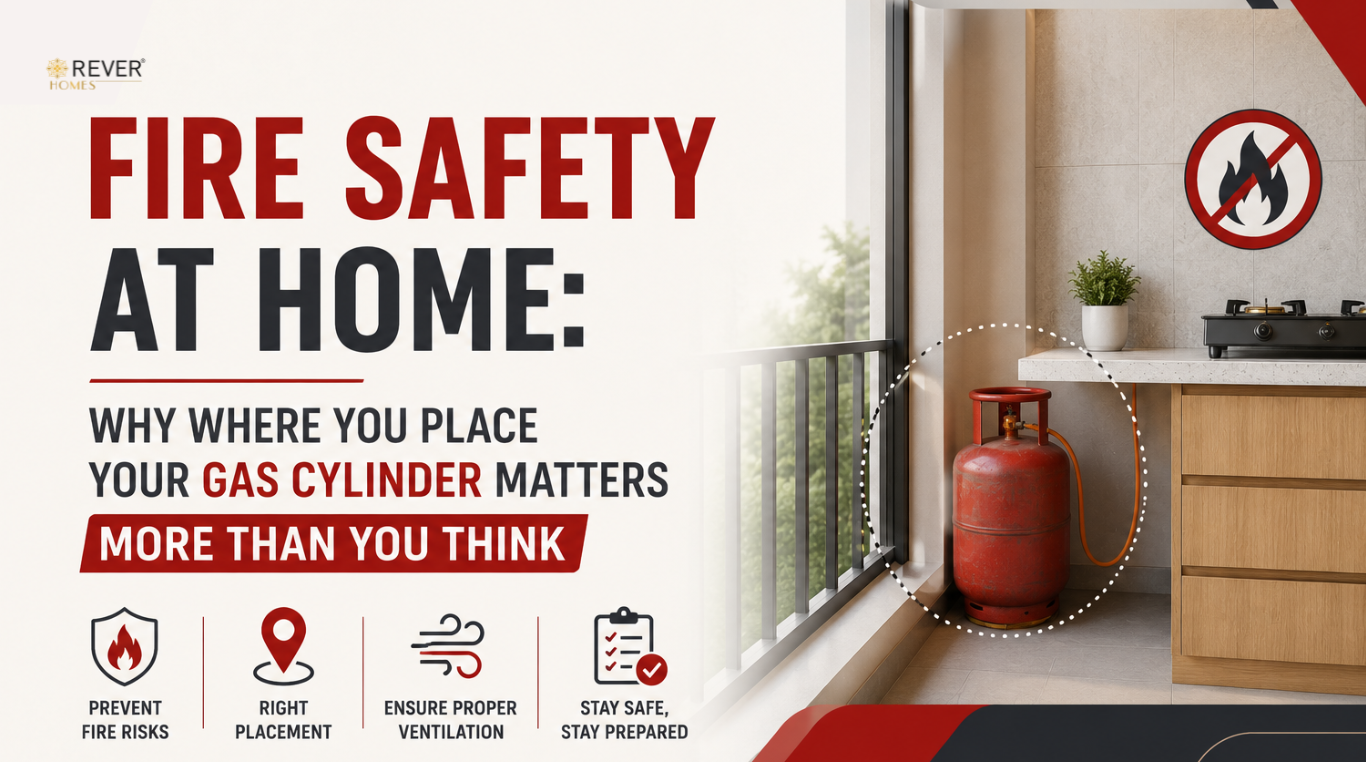
LPG gas is heavier than air. In a closed, poorly ventilated space, any leaked gas doesn't just disperse into the air — it settles near the floor and lingers, waiting for a single spark to ignite it. A cylinder kept inside a sealed cupboard or a tightly closed storeroom is far riskier than one kept in an open, airy space.
2. Proximity to Exits
This is the one almost nobody thinks about until it's too late. If your cylinder is placed right next to your main door, staircase, or the only way out of a room, it becomes a direct threat to your escape route — exactly when you'd need it most. In the Hari Nagar incident, the cylinders were in a parking area that residents would have needed to pass through.
3. Overcrowded, Unplanned Storage
In many homes — especially older buildings or spaces where storage was never properly planned — cylinders end up crammed into parking corners, narrow passages, or storerooms alongside other flammable material like wood, paint tins, or stacks of cardboard. A single spark in a space like this doesn't stay small for long.
Simple Safety Habits Every Household Should Follow
None of this requires expensive changes — just a bit of awareness and a few consistent habits.
1. Never place your cylinder near an exit door, staircase, or your only way out. If something goes wrong, that path needs to stay clear.
2. Store it in a ventilated space, never sealed inside a closed cupboard or airtight corner.
3. Keep a safe distance from electrical switchboards, wiring, and open flames. Even a small spark nearby is a genuine risk.
4. Check regularly for gas leaks using soap water on the regulator and pipe joints — bubbles forming means there's a leak.
5. Avoid stacking multiple cylinders together in tight, shared, or poorly ventilated spaces.
6. Keep a fire extinguisher within reach in the kitchen or utility area, and make sure every adult at home knows how to use it.
Small habits like these take a few minutes to build, but they can be the reason a small mistake never turns into a bigger one.
Why This Often Comes Down to How the Home Was Originally Built
Here's something most people never connect the dots on: many of these risks aren't things that go wrong after you move in — they're mistakes baked in at the construction stage itself. A kitchen with no ventilation planned in. A parking area where the only "free corner" for the cylinder happens to be right next to the exit. A utility space with zero separation between the cylinder and flammable storage.
These aren't homeowner carelessness — they're layout and design oversights that happen when safety isn't part of the planning conversation from day one.
How We Think About This at Rever Homes
At Rever Homes, this is something we take seriously in every residential project we build across Delhi and Gurugram. When we plan a kitchen or utility area, ventilation isn't an afterthought — it's part of the design from the very first floor plan. We make sure cylinder storage areas are placed with a safe distance from exits, staircases, and electrical points, and that there's enough dedicated space so a cylinder never gets pushed into a cramped, high-risk corner simply because nothing else was planned for it.
We've seen too often how a construction mistake made years ago — a poorly ventilated utility space, a parking layout with no thought given to emergency access — ends up becoming a genuine safety hazard for a family who had no idea it was even a risk. That's exactly the kind of oversight we design against from the start, whether it's a new home we're building or an existing layout we're helping a family renovate.
If you're planning new home construction or a renovation in Delhi or Gurugram, this is a conversation worth having with your construction company before your kitchen or parking layout is finalized — not after an incident forces the issue.
A Small Habit That Can Prevent a Big Loss
Incidents like the one in Hari Nagar aren't meant to scare us — they're meant to remind us that safety often comes down to small, consistent habits and thoughtful planning, not luck.
Take a few minutes today. Walk over to where your cylinder is stored. Ask yourself honestly: is it blocking an exit? Sitting in an unventilated corner? Too close to something flammable? If the answer is yes, it's worth fixing today, not waiting for a reason to regret it later.
And if you're planning to build or renovate a home in Delhi or Gurugram, let's make sure safety isn't something you have to think about after the fact — it should be part of the home from the very first design decision.
Talk to us about building a home in Delhi or Gurugram where safety is designed in from day one.