Your loan gets sanctioned for 40 lakhs. The bank hands you 8 lakhs. You're staring at a foundation bill that's already due. What happened?
Nothing went wrong. This is exactly how construction loan disbursement stages work in India. Banks never release the full amount upfront. They pay in tranches, tied to how much of your house physically exists on the ground.
At Rever Homes, we've built more than 100 homes across Gurugram and Delhi-NCR, and we've sat through dozens of bank inspection visits with clients. The pattern repeats every time. Families budget assuming lump-sum funding, then panic when stage one covers less than expected. This guide breaks down exactly how the staged disbursal system works, so nothing on your site catches you off guard.
Why Banks Never Release the Full Loan Upfront
Think about it from the lender's side. If a bank hands over the entire sanctioned amount on day one, it has zero leverage if construction stalls, funds get diverted, or the house never gets built to plan. Staged disbursal protects the bank's money and, honestly, it protects yours too.
Every disbursal ties to a construction milestone the bank's engineer can physically verify. No verified progress, no next tranche. Simple as that.
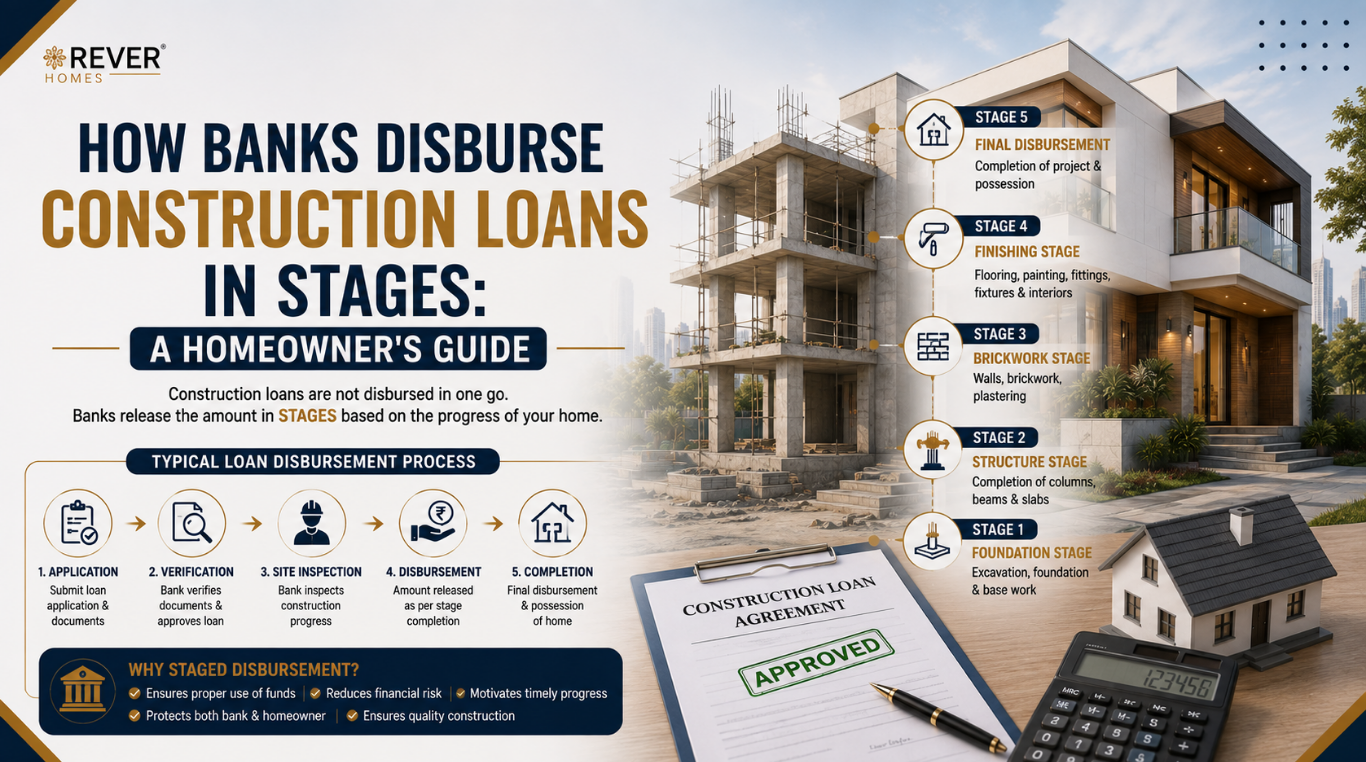
The Five Standard Disbursement Stages
Most Indian lenders, from SBI to housing finance companies, follow a similar milestone structure. The exact percentages shift slightly bank to bank, but the sequence stays consistent.
Stage 1: Foundation Level, roughly 15-25% of the loan. Released once the plot purchase is complete, the building plan is DTCP-approved, and foundation work has actually started. The bank's engineer confirms this on-site before a single rupee moves.
Stage 2: Plinth and Column Level, roughly 20-25%. This covers the point where the foundation is finished, the plinth is cast, and columns are going up. It's usually the second-largest tranche, since structural work eats the budget fast.
Stage 3: Lintel and Roof Level, roughly 25-30%. Typically the biggest release. The roof slab is cast, walls are rising, and the shell of the house is visible. This stage often decides your project's real momentum.
Stage 4: Brickwork and Plastering, roughly 15-20%. Brick walls, plastering, and door and window fitting fall here. The house starts looking like a house.
Stage 5: Finishing, the remaining balance. Flooring, electrical wiring, plumbing, and painting. The last tranche lands once the home is nearly move-in ready.
Five stages, five inspections, five separate reasons your money might not arrive the week you need it.
What Happens Before Each Disbursal
Every stage follows the same loop. Site work reaches a milestone. You, or your contractor, notify the bank. An engineer visits and certifies the progress against the sanctioned plan. Only then does the bank release funds, usually straight to your account or, in some cases, directly to your contractor.
Miss a document, and the whole cycle resets. We've seen inspection dates slip two to three weeks simply because a client's architect hadn't signed off on a progress certificate. Keep that paperwork ready before you even call for inspection. Don't wait.
Pre-EMI: The Part Nobody Explains Clearly
Here's where most first-time borrowers get caught off guard. During construction, you don't pay a full EMI on the sanctioned loan amount. You pay Pre-EMI, which is interest only, calculated on whatever's actually been disbursed so far.
Say your sanctioned loan is 30 lakhs at 8% per year, and the bank has released 5 lakhs after stage one. Your Pre-EMI is interest on that 5 lakhs, not on 30 lakhs. As each tranche lands, your Pre-EMI rises with it. Full EMI, covering both principal and interest, only kicks in once the loan fully converts after construction wraps up.
This matters for budgeting. Many families assume their EMI stays fixed from day one. It doesn't. It climbs stage by stage.
Why Stage One Feels Like a Shock
Foundation work is deceptively expensive. Excavation, PCC, footings, and steel work chew through a big share of your total budget, often 30 to 35% in real terms. But stage one disbursal typically caps at 25%.
That gap is the single biggest cash-flow squeeze in the entire build. We plan for it on every project. Clients who keep a buffer equal to one extra month's site expenses rarely feel the pinch. Clients who don't, do.
Documents the Bank Wants at Every Stage
1. Progress certificate from your architect or site engineer
2. Photographs of current construction stage
3. Updated site inspection request form
4. Contractor or material invoices, where the bank asks for proof of spend
5. Approved plan copy, for cross-verification against actual construction
Keep digital copies ready from day one. Chasing paperwork mid-construction wastes time you don't have.
How to Avoid Delays Between Stages
A few habits keep the disbursal cycle moving instead of stalling.
Schedule your construction milestones with the bank's inspection calendar in mind, not just your contractor's pace. Sound overly cautious? It isn't. Banks don't fast-track inspections because your site is ahead of schedule.
Keep one point of contact with your bank, ideally the same relationship manager throughout. Switching contacts mid-project usually means re-explaining your file from scratch.
Never start the next construction phase purely on verbal assurance from your bank. Wait for the actual credit to hit your account, or get written confirmation of imminent release.
How Rever Homes Plans Around This
We sequence our build schedules to match how banks actually pay out, not just how fast a crew can pour concrete. Foundation, structure, brickwork, and finishing map almost exactly onto the five disbursal stages most lenders use.
That alignment means fewer stalled weeks waiting on a tranche, and fewer awkward calls to your contractor asking for more time. Across DLF Phases, Sushant Lok, Sector 39, and Sohna, we've run this cycle with client after client. It works when the schedule and the bank's calendar move together, not apart.
Planning a self-build in Gurgaon and want your construction schedule to match your loan's disbursal stages? Talk to Rever Homes for a build plan that keeps pace with your bank, or check your budget with our cost calculator.